Why would you use a heat pump? Heat pump systems are highly efficient, can heat AND cool your home and qualify for tax credits and rebates!
Quickly, I’ll discuss the terms “mini-split”, “heat pump” and “mini-split heat pumps”.
A “split” system simply refers to the fact that there is an outdoor unit (aka a compressor) and an indoor unit (aka indoor air handler or fan coil).
“Mini-splits” are typically ductless split systems.
“Heat pump” refers to the type of technology that is being utilized (for example, your refrigerator uses heat pump technology and you’ll notice that it’s cold on the inside but warm underneath the unit). This type of technology is capable of heating AND cooling, but it does not create warm or cold air, it MOVES this air from the outside to inside during the winter and vice versa in the summer, utilizing the compressor, which raises or lowers the temperature as needed. A heat pump system can be ductless or ducted.
Finally, a “mini-split heat pump” is a ductless system that utilizes the heat pump technology and offers both heating and cooling.
Advantages
Efficiency – Heat pumps are typically around 250 – 400+% efficient. The industry uses a metric called the Coefficient of Performance (COP) to rate system performance. If a heat pump has a COP of 3.67 at 47F, it means that it will be 367% efficient while operating at 47F.
Tax Rebates – Both the State of Colorado ($1500) and local utilities offer rebates if you choose to install these and can be put towards new construction or upgrades to your existing home.
The Federal IRA, Energy Efficient Home Improvement Credit (25C) can be utilized if you are updating your existing system. The credit is 30% of project cost, up to $2,000. For more details, visit this site.
Flexible Installation Options – You can supply conditioned air to separate rooms without ductwork, and have these rooms on different temperature settings. There are also many option of inside units and additional options, such as zoning, explained below.
Installation Options – Ducted / Ductless
Now, you can choose to have a ducted system similar to a more traditional forced air furnace system, which ductwork providing heated (or cooled) air to each room via ductwork OR you can opt to have a ductless system, which would include a ceiling or wall unit in each room, where necessary, eliminating the ductwork.
- Ducted – This is a good application if the heating / cooling loads per room are much less than what the indoor unit would provide, i.e. an indoor unit is typically 6k BTUh minimum, which could be much more than a bedroom actually needs. You want the heat pump to operate in it’s “Goldilocks” zone (between its minimum and maximum) and if asked to operate below the minimum, it can cycle more and have decreased efficiency. Again, a good room-by-room mechanical load calculation (Manual J) should be done to accurately design a system.
- Flip Side – ductwork will supply air to each room, taking up space and may cost more; a duct leakage test will also need to be performed to ensure the air is getting where it needs to and the efficiency of the units can be realized.
- Ductless – more efficient, easier to install as you don’t need to run large ductwork in the floor / ceiling / wall, but will require a separate means to get fresh air (mechanical ventilation) throughout the house. You can achieve this, however, by utilizing an energy recovery ventilation system (ERV). Please contact Full Circle on what this entails.
Installation Options – Indoor Units
What does this look like on the inside of the house? There are many options for the indoor unit. Note that you can also mix and match the unit types.
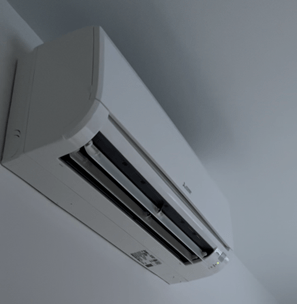
- Wall-mounted units – this is the more common and cost effective measure; installed out of the way of furniture; some people do not the look of these units.
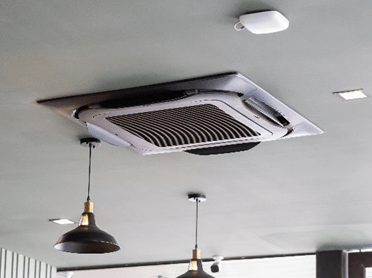
- Ceiling cassette units – will be flush-mounted in the ceiling.
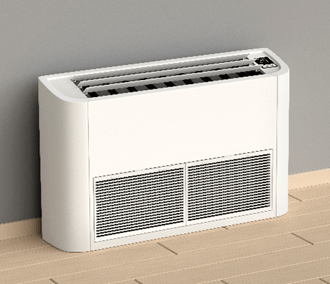
- Floor units – similar to radiator units; takes up space where furniture may go.
Cold Temperature Operation
If you live in a colder climate, you will need to make sure that your mini split will operate at colder temperatures; this can be verified on the equipment spec sheet.
Some mini splits (i.e., Mitsubishi Hyper Heat (H2i) line) achieve this by running “backwards” briefly, into a “defrost mode”, to melt any ice that has formed on the outside condenser. Note that the Mitsubishi Hyper Heat line (H2i) line will operate down to 5F without any impact on the capacity / output and can operate down to -13F, with only a slight impact on capacity / output.
Some people opt to use backup heat, which is typically an electric resistance strip (installed at the unit) or could also be a fireplace or another means of heating.
Zoning
The IRC requires that each bedroom and kitchen need heating, also referred to as a “zone”. You can typically have 2-8 zones for each outdoor condenser.
You can install single-zone mini splits, which is one outdoor unit to one indoor unit, but if you’re adding indoor units to multiple rooms, you should consider a multi-zone mini split, which can have one outdoor unit and 2 to 8 indoor units.
Mitsubishi Sizing / Zoning –
- 2 zone / 20,000 BTUH
- 3 zone / 24,000 BTUH
- 3 zone / 30,000 BTUH
- 4 zone / 36,000 BTUH
- 5 zone / 42,000 BTUH
- 8 zone / 48,000 BTUH
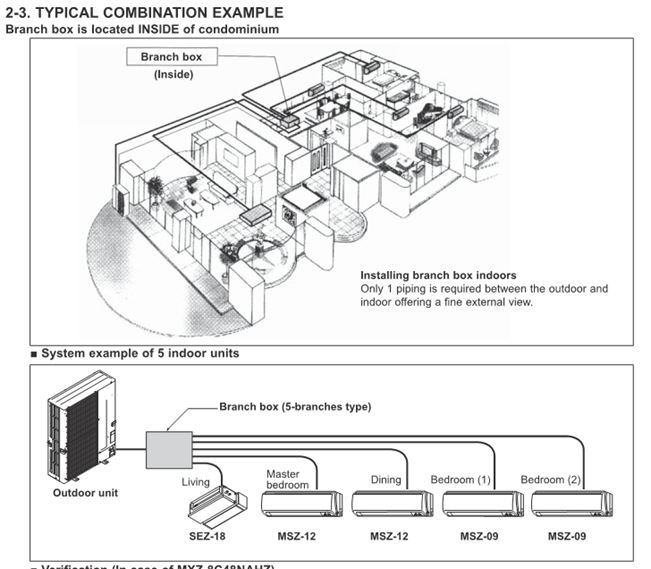
Branch Box – this enables you to have only one penetration in the exterior wall to run the piping lines, see photo above. If this is not utilized, you will have TWO lines per each indoor head running from the outdoor unit, to the inside, i.e. larger hole on the exterior and more refrigerant piping.
Contact Full Circle for any questions! Email: amanda@fullcircleconstruction.org
 Full Circle Construction Services