Mechanical Ventilation –
When you think of ventilation you typically think of bathroom exhaust and kitchen hood exhaust. While these are required and their efficiency is important, fresh air is also important, especially in tighter homes. Having the ability to control and filter clean air from the outside and disperse it throughout your house, while exhausting stale air is the goal here. Windows can provide this, but if there is not proper wind or temperature, airflow cannot happen. Also, windows cannot filter out pollen dust, rain, noise, critters, or people. This is why the energy code does not allow natural ventilation; mechanical ventilation is required.


Think of mechanical ventilation as your lungs. Your lungs are dedicated to breathing and only breathing. This is how mechanical ventilation should be thought of; completely independent of the heating and air conditioning.

Taking this one step further… If you breathe through your nose, that air is filtered by the nose hairs. It’s also conditioned, and therefore able to more easily distribute throughout your body (think ERV/HRV, which we’ll get into later). Mouth breathing, while it is somewhat effective, is very much not efficient and if you only breathe only through your mouth, you will experience detrimental health, such as dental issues, sleep disorders, learning disabilities, etc. Mouth breathing can be equated to running fresh air into the return of a system.

You could also think of filters in the system as having a snotty nose, the airflow is greatly inhibited and therefore making sure that your filters are clean is very important.
Before we get too far ahead of ourselves, let’s first talk about what is allowed by code.
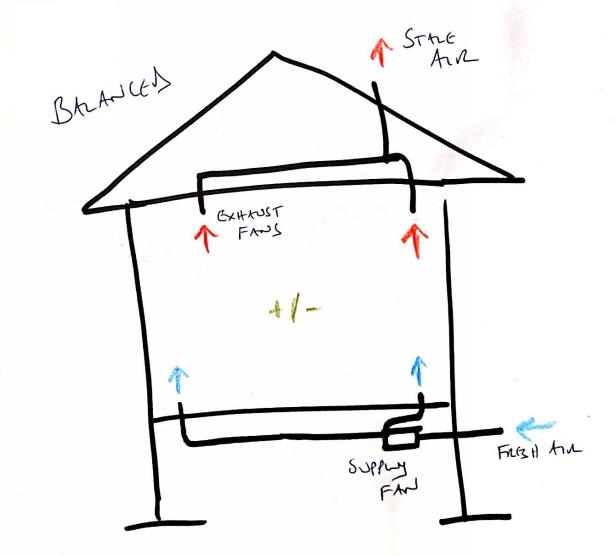
Technically speaking, the code does allow three types of ventilation. This is either supply-only, exhaust-only (most common in the Colorado region, using bathroom exhaust fans) or balanced ventilation via an ERV (energy recovery ventilator) or an HRV (heat recovery ventilator). If you live in climate zones seven or eight (and are under the 2021 IECC, or greater), however, you are required to install a balanced ventilation system. Supply-only and exhaust-only are better than nothing, but a balanced ventilation system should be your standard as the house will not be pressurized or depressurized. You wouldn’t want to only inhale or only exhale right?
SUPPLY-ONLY
The closest to a supply-only system that I’ve seen in Colorado, is running a fresh air duct to the return of a system, aka mouth-breathing. This method simply adds fresh air to the existing air, but basically dilutes the existing air and would require additional controls to ensure that the right amount of fresh air is added to the system. Because controls in combination with a damper, are not always installed, this fresh air duct just a hole in the building’s envelope, which is not ideal. In warmer climates, this is more common and it is essentially just a fresh air duct with a filter and fan that pulls the fresh air from outside and supplies it to the most occupied rooms of the house (typically a bedroom or living room). Backdrafting of appliances would not be an issue because the house is pressurized. In cold climates, however, this would potentially cause mold as the warmer humid air from the inside will go outside and can condense the wall cavities.
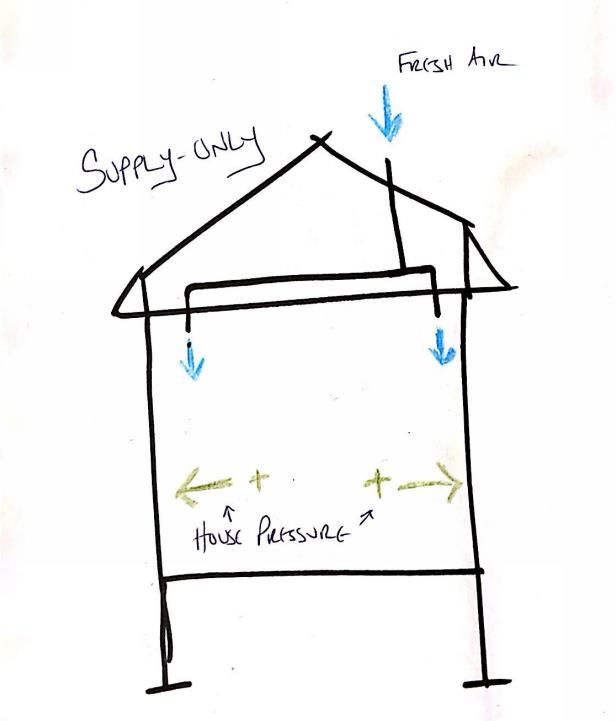
EXHAUST-ONLY
An exhaust-only system exhausts the air indoors (that you have paid to heat or cool), to the outdoors. The exhausted air must then be replaced by new outdoor air that now needs to be RE-heated or RE-cooled. This incoming air is not filtered and it is not controlled nor is it told where to go. Therefore, a larger amount of air is needed, because a lot of it is wasted. This system can be run continuously or intermittently. A damper is needed on the exterior and it shall close when the system is not in use. This type of ventilation should never be used if you have open combustion appliances, such as a furnace, boiler, or water heater as they can potentially backdraft harmful gases into the home. These systems are also most common in cold climates, as they would be a concern for mold in warmer climates because the building is depressurized, asking warm, moist air on the outside will be drawn inside, condensing in the wall cavities.
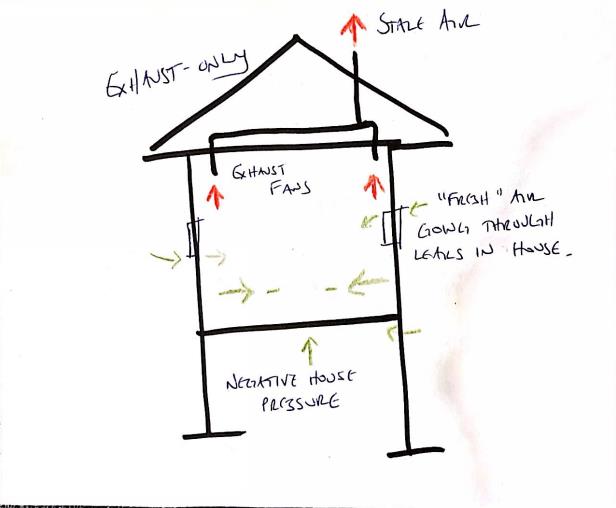
BALANCED VENTILATION
Balanced ventilation systems consist of either an HRV or ERV. The ERV is capable of handling a latent load and should be used in drier climates as it’ll keep any added humidity inside your home.
In the ERV/HRV, the energy is transferred from one channel to the next channel. For example, in the winter, the stale, warm indoor air is exhausted, but the temperature is used to heat up the incoming fresh air, so you are not dumping cold winter air into the house. In an ERV, the humidity is also transferred to the incoming air. The energy or temperature difference is captured at anywhere from 65 to 90% efficiency; the humidity capture difference is usually around 50%.
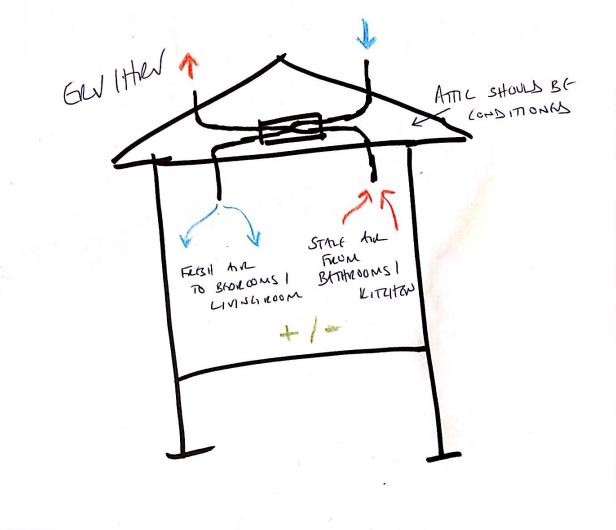
ERV/HRV out of your budget? You could also achieve balanced ventilation by pairing exhaust fans with a supply. An example of this would be Panasonic WhisperGreen bathroom fans tied to the Panasonic SelectCycler, which basically provides fresh air matching the amount of air that is exhausted from the bathroom fans. A demonstration video of this is here: https://youtu.be/GAbXg36bF3c?si=l90sfIPk7sByTPu4
Product Links –
Panasonic Select Cycler – https://na.panasonic.com/us/home-and-building-solutions/ventilation-indoor-air-quality/ventilation-systems/selectcyclerr-whole-house-ventilation-solution
Panasonic WhisperGreen – https://na.panasonic.com/us/home-and-building-solutions/ventilation-indoor-air-quality/ventilation-fans/whispergreenr-select-fan-50-80-110-cfm
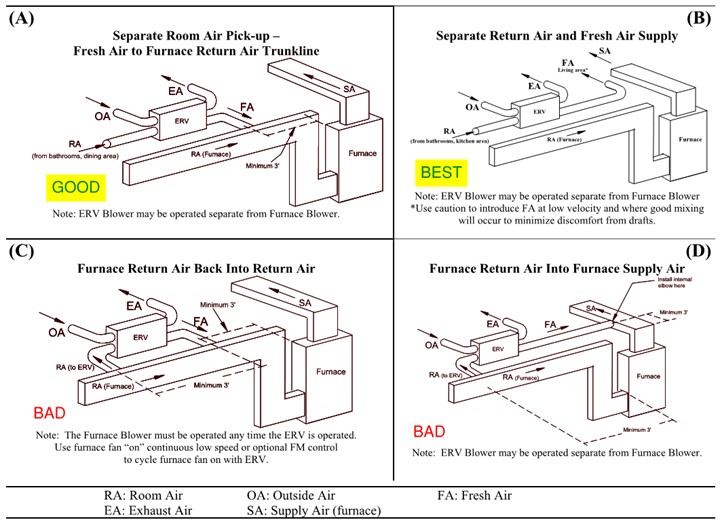
Remember when I mentioned that these systems should be separate, just like your lungs are independent? Remember this! There are many ways to duct an ERV/HRV, as you can see in the Renewaire installation instructions below, but only the top right is considered the “best”. The furnace will not always run, but the fresh air shall be on 24/7. You could also consider tying in the bathroom exhausts into the return air of the ERV/HRV, if the manufacturer allows this. This would reduce your exterior penetrations and make up for some of the “extra work” for the ventilation.
HOW MUCH VENTILATION?
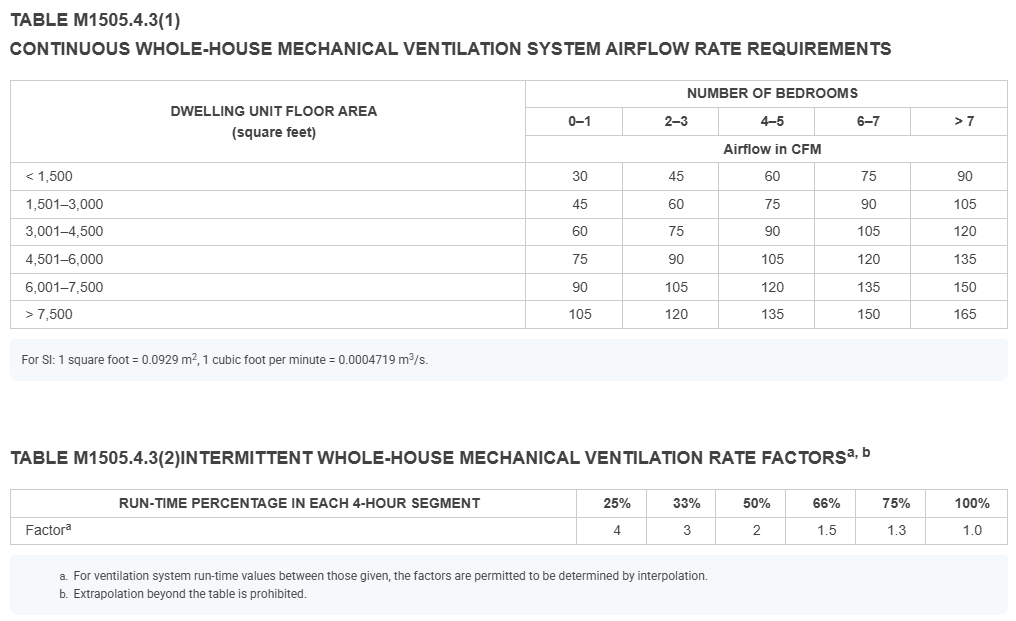
The IRC and IECC require that any dwelling that has less than 5 ACH50 (air changes per house at 50 Pascals), requires mechanical ventilation. Since this level of airtightness is required anyways, so is mechanical ventilation! The 2021 IRC refers you to this table to determine the minimum ventilation required. Note that you do not want to provide a lot more ventilation than is required, because then this results in an efficiency hit. Hence why the amount of ventilation is required (under the 2021 IECC) to be tested by a third party to verify these numbers are being hit.
CONCLUSION
Ok, so we’ve now discussed how to get fresh air into a home, and the benefits and drawbacks of some of the methods. Here’s some takeaways:
- Fresh air is necessary and it is best to control, filter and disperse this air instead of relying on natural ventilation via windows.
- Supply-only is more common in warmer climates.
- Exhaust-only is more common in colder climates and should not be used with open combustion appliances.
- Balanced ventilation can be achieved by combining supply-only and exhaust-only as well as using an ERV/HRV.
- An ERV handles the latent load / humidity, which is why it’s best in drier climates.
- Keeping the mechanical ventilation separate from the heating and cooling of the house is recommended.
- The amount of ventilation required is determined by the codes.
Stay tuned for the next captivating topic… crawlspace ventilation / conditioning!
 Full Circle Construction Services