An ERV an excellent way to bring fresh air into the house with a minimal energy hit (and helps maintain humidity levels which is important in our dry climate). It does matter, however, how you duct the ERV to properly distribute air throughout the house. This install unfortunately is not up to its potential. Proper mixing and distribution is not happening. HVAC should never be an afterthought and proper planning for layout is needed prior to framing and rough-in.
When your range hood is exhausting, if it doesn’t have adequate makeup air to replace the air that’s getting exhausted, it won’t work as it should. Think of drinking out of a straw that has fruit remnants at the bottom of it… it’s not going to work that well. Check out the video to see how much a range hood can depressurize your house and different methods to help with equalizing this pressure via passive or mechanical makeup air.
The building code requires makeup air if a range hood is in excess of 400 CFM (IRC M1503.6), but it turns out makeup air may be required for any range hood if your house is airtight. Makeup air allows the range hood to operate efficiently and also ensures proper indoor air quality so that any open combustion appliances aren’t backdrafting into the house.
Join me on a walkthrough of a home under construction as I point out critical details to keep the air barrier continuous and effective.
Whether you’re a builder, architect, energy rater, or homeowner, knowing where air leaks can happen—and how to prevent them—will help you build a tighter, more efficient, and more comfortable home.
In this video, you’ll see:
✅ How to spot common air barrier weak points
✅ Tips to prevent air leakage before drywall installation
✅ Why a tight building envelope improves energy efficiency and indoor comfort
✅ How proactive inspections help pass blower door testing and meet IECC energy codes
📍 Full Circle Construction Services — Helping builders, architects, and homeowners meet code, improve comfort, and seal performance gaps.
Imagine trying to heat or cool your home while leaving a window cracked all year. That’s essentially what happens when your home leaks air—and most buildings do, a lot more than you’d think.
At Full Circle Construction Services, we run the numbers every day. And when it comes to air leakage, the math is crystal clear: leaky homes cost more to heat, cool, and maintain.
🏠 Just How Much Air is Leaking?
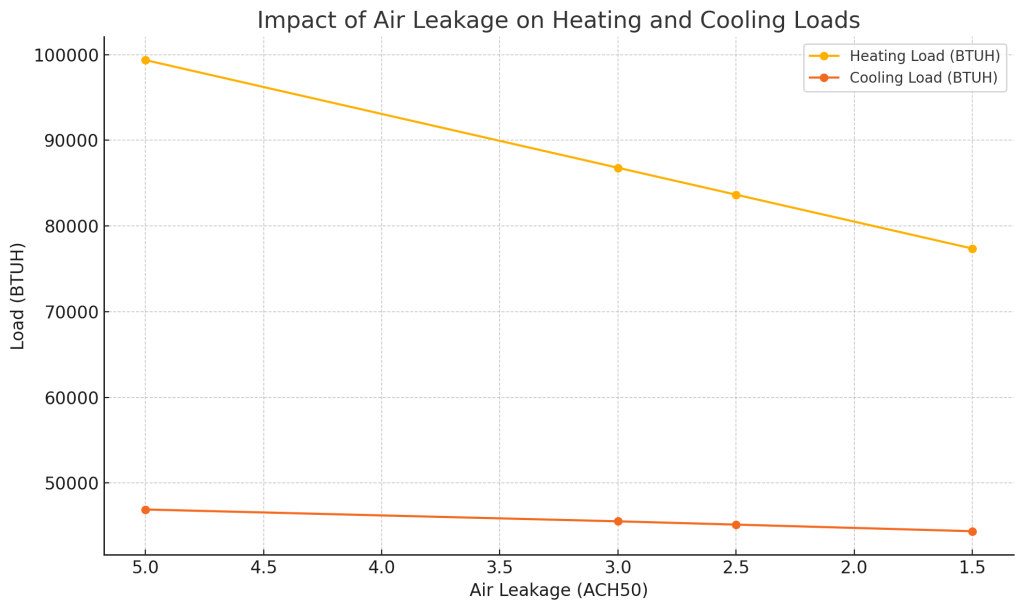
When we test a home’s air leakage with a blower door, we get results in ACH50 (air changes per hour at 50 Pascals). Here’s what we found for one project:
Air Leakage
Hole Size (approx.)
Heating Load
Cooling Load
5 ACH50
445 sq in (3.1 sq ft)
99,354 BTUH
46,916 BTUH
3 ACH50
267 sq in (1.85 sq ft)
86,789 BTUH
45,536 BTUH
2.5 ACH50
223 sq in (1.55 sq ft)
83,650 BTUH
45,152 BTUH
1.5 ACH50
134 sq in (0.93 sq ft)
77,365 BTUH
44,382 BTUH
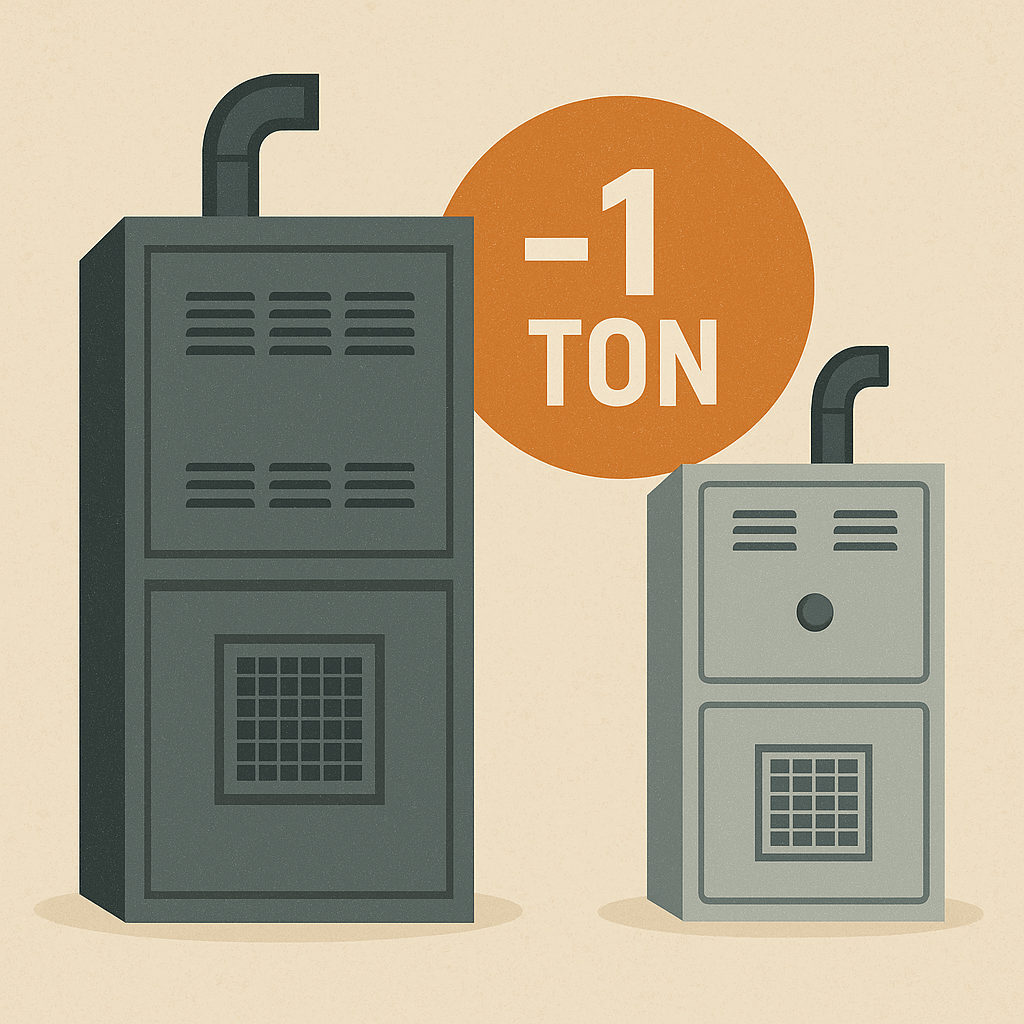
📉 That’s a 22,000 BTU drop in heating load just by tightening the home from 5 ACH50 to 1.5. That’s nearly one ton of heating load reduction—the size of an entire small furnace or heat pump!
Why Does This Matter?
Here’s what happens when your home leaks:
Your HVAC system has to work harder to maintain comfort.
You may need larger equipment, which costs more upfront.
That system runs less efficiently, leading to higher utility bills.
Comfort suffers—think drafts, temperature swings, and overworked equipment.
“It’s like trying to heat a bathtub with the drain open. You can keep pouring hot water in… but you’re wasting money doing it.”
Sealing = Saving
By reducing leakage, you’re doing more than saving energy—you’re unlocking:
✅ Smaller HVAC systems (lower cost)
✅ Lower monthly energy bills
✅ Improved comfort and air quality
✅ Longer-lasting mechanical equipment
Every time we cut air leakage, we also cut the heating load—and that makes homes more affordable to build and to operate.
Want to learn how to make your home or building leak less? Contact Full Circle today!
When you think of ventilation you typically think of bathroom exhaust and kitchen hood exhaust. While these are required and their efficiency is important, fresh air is also important, especially in tighter homes. Having the ability to control and filter clean air from the outside and disperse it throughout your house, while exhausting stale air is the goal here. Windows can provide this, but if there is not proper wind or temperature, airflow cannot happen. Also, windows cannot filter out pollen dust, rain, noise, critters, or people. This is why the energy code does not allow natural ventilation; mechanical ventilation is required.
Think of mechanical ventilation as your lungs. Your lungs are dedicated to breathing and only breathing. This is how mechanical ventilation should be thought of; completely independent of the heating and air conditioning.
Taking this one step further… If you breathe through your nose, that air is filtered by the nose hairs. It’s also conditioned, and therefore able to more easily distribute throughout your body (think ERV/HRV, which we’ll get into later). Mouth breathing, while it is somewhat effective, is very much not efficient and if you only breathe only through your mouth, you will experience detrimental health, such as dental issues, sleep disorders, learning disabilities, etc. Mouth breathing can be equated to running fresh air into the return of a system.
You could also think of filters in the system as having a snotty nose, the airflow is greatly inhibited and therefore making sure that your filters are clean is very important.
Before we get too far ahead of ourselves, let’s first talk about what is allowed by code.
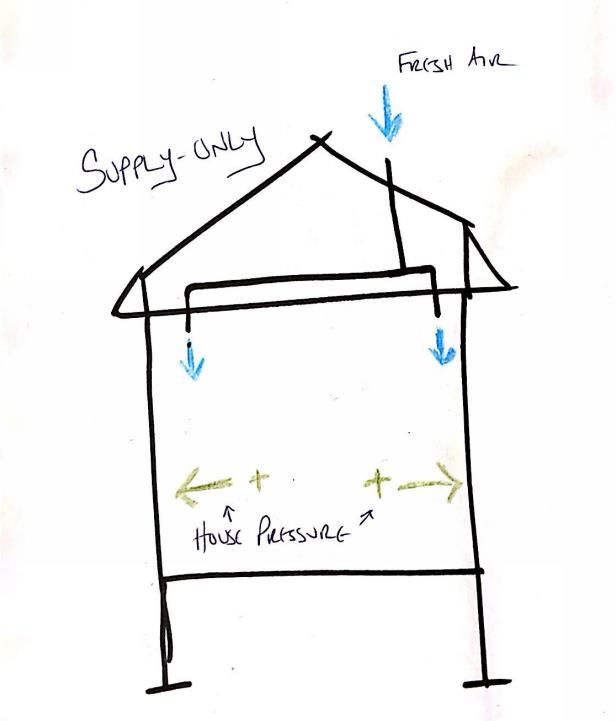
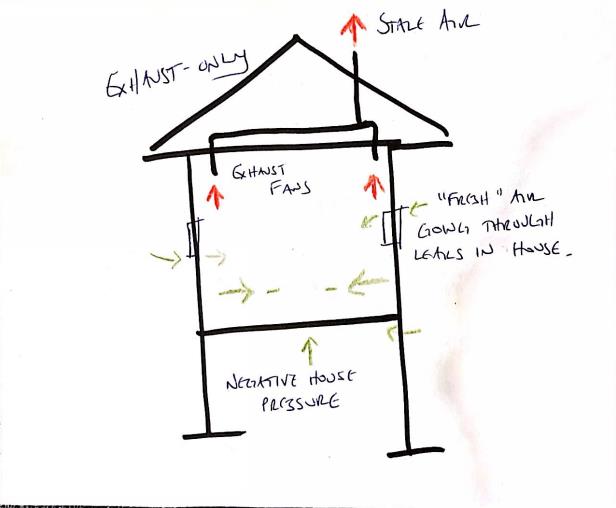
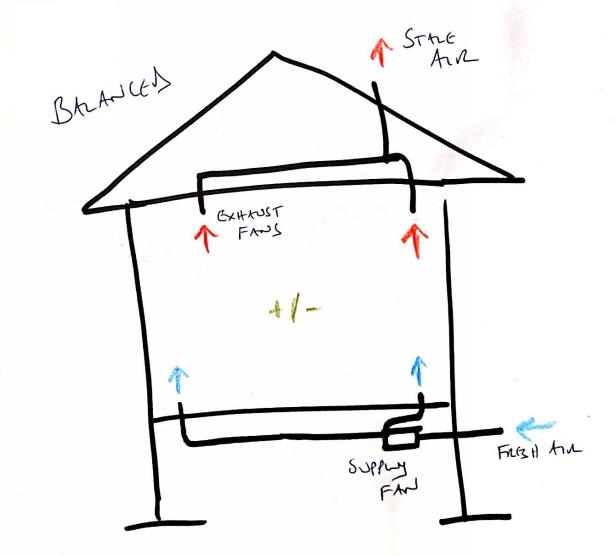
Technically speaking, the code does allow three types of ventilation. This is either supply-only, exhaust-only (most common in the Colorado region, using bathroom exhaust fans) or balanced ventilation via an ERV (energy recovery ventilator) or an HRV (heat recovery ventilator). If you live in climate zones seven or eight (and are under the 2021 IECC, or greater), however, you are required to install a balanced ventilation system. Supply-only and exhaust-only are better than nothing, but a balanced ventilation system should be your standard as the house will not be pressurized or depressurized. You wouldn’t want to only inhale or only exhale right?
SUPPLY-ONLY
The closest to a supply-only system that I’ve seen in Colorado, is running a fresh air duct to the return of a system, aka mouth-breathing. This method simply adds fresh air to the existing air, but basically dilutes the existing air and would require additional controls to ensure that the right amount of fresh air is added to the system. Because controls in combination with a damper, are not always installed, this fresh air duct just a hole in the building’s envelope, which is not ideal. In warmer climates, this is more common and it is essentially just a fresh air duct with a filter and fan that pulls the fresh air from outside and supplies it to the most occupied rooms of the house (typically a bedroom or living room). Backdrafting of appliances would not be an issue because the house is pressurized. In cold climates, however, this would potentially cause mold as the warmer humid air from the inside will go outside and can condense the wall cavities.
EXHAUST-ONLY
An exhaust-only system exhausts the air indoors (that you have paid to heat or cool), to the outdoors. The exhausted air must then be replaced by new outdoor air that now needs to be RE-heated or RE-cooled. This incoming air is not filtered and it is not controlled nor is it told where to go. Therefore, a larger amount of air is needed, because a lot of it is wasted. This system can be run continuously or intermittently. A damper is needed on the exterior and it shall close when the system is not in use. This type of ventilation should never be used if you have open combustion appliances, such as a furnace, boiler, or water heater as they can potentially backdraft harmful gases into the home. These systems are also most common in cold climates, as they would be a concern for mold in warmer climates because the building is depressurized, asking warm, moist air on the outside will be drawn inside, condensing in the wall cavities.
BALANCED VENTILATION
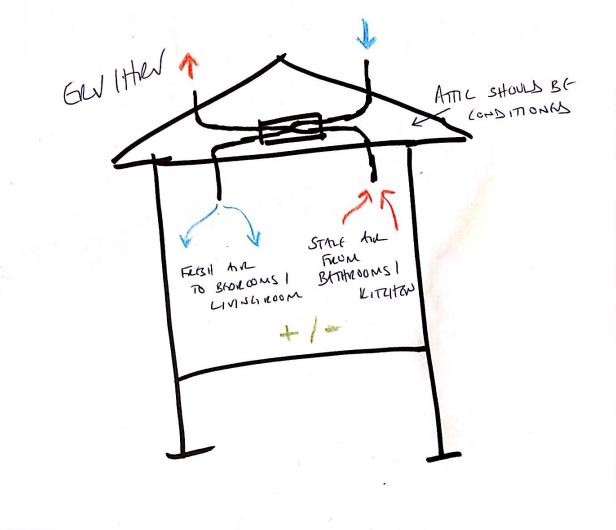
Balanced ventilation systems consist of either an HRV or ERV. The ERV is capable of handling a latent load and should be used in drier climates as it’ll keep any added humidity inside your home.
In the ERV/HRV, the energy is transferred from one channel to the next channel. For example, in the winter, the stale, warm indoor air is exhausted, but the temperature is used to heat up the incoming fresh air, so you are not dumping cold winter air into the house. In an ERV, the humidity is also transferred to the incoming air. The energy or temperature difference is captured at anywhere from 65 to 90% efficiency; the humidity capture difference is usually around 50%.
ERV/HRV out of your budget? You could also achieve balanced ventilation by pairing exhaust fans with a supply. An example of this would be Panasonic WhisperGreen bathroom fans tied to the Panasonic SelectCycler, which basically provides fresh air matching the amount of air that is exhausted from the bathroom fans. A demonstration video of this is here: https://youtu.be/GAbXg36bF3c?si=l90sfIPk7sByTPu4
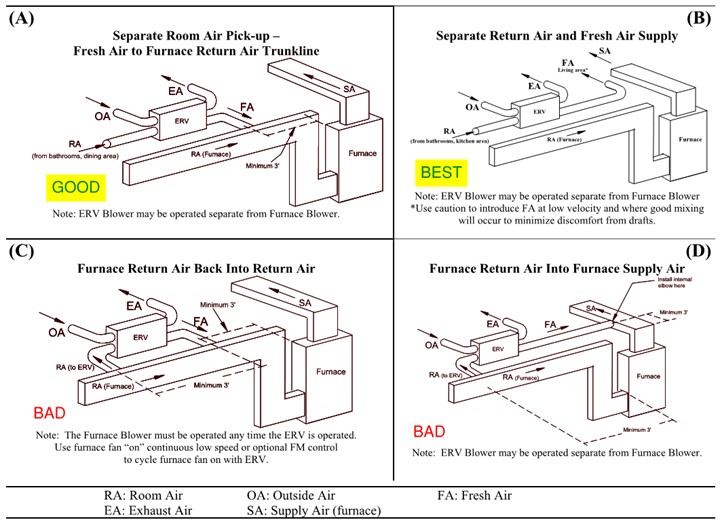
Remember when I mentioned that these systems should be separate, just like your lungs are independent? Remember this! There are many ways to duct an ERV/HRV, as you can see in the Renewaire installation instructions below, but only the top right is considered the “best”. The furnace will not always run, but the fresh air shall be on 24/7. You could also consider tying in the bathroom exhausts into the return air of the ERV/HRV, if the manufacturer allows this. This would reduce your exterior penetrations and make up for some of the “extra work” for the ventilation.
HOW MUCH VENTILATION?
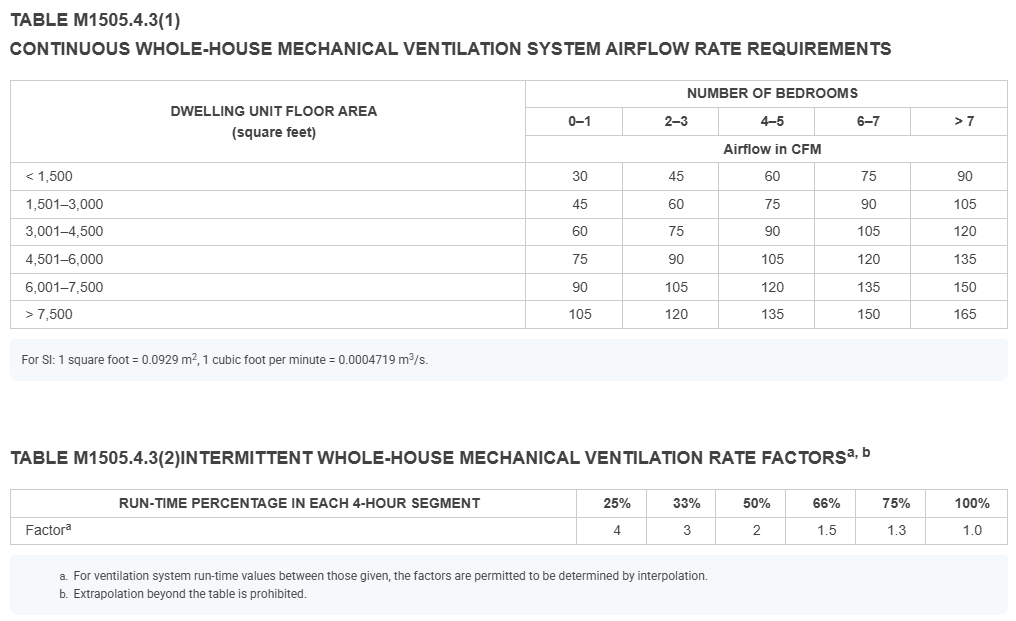
The IRC and IECC require that any dwelling that has less than 5 ACH50 (air changes per house at 50 Pascals), requires mechanical ventilation. Since this level of airtightness is required anyways, so is mechanical ventilation! The 2021 IRC refers you to this table to determine the minimum ventilation required. Note that you do not want to provide a lot more ventilation than is required, because then this results in an efficiency hit. Hence why the amount of ventilation is required (under the 2021 IECC) to be tested by a third party to verify these numbers are being hit.
CONCLUSION
Ok, so we’ve now discussed how to get fresh air into a home, and the benefits and drawbacks of some of the methods. Here’s some takeaways:
Fresh air is necessary and it is best to control, filter and disperse this air instead of relying on natural ventilation via windows.
Supply-only is more common in warmer climates.
Exhaust-only is more common in colder climates and should not be used with open combustion appliances.
Balanced ventilation can be achieved by combining supply-only and exhaust-only as well as using an ERV/HRV.
An ERV handles the latent load / humidity, which is why it’s best in drier climates.
Keeping the mechanical ventilation separate from the heating and cooling of the house is recommended.
The amount of ventilation required is determined by the codes.
Stay tuned for the next captivating topic… crawlspace ventilation / conditioning!
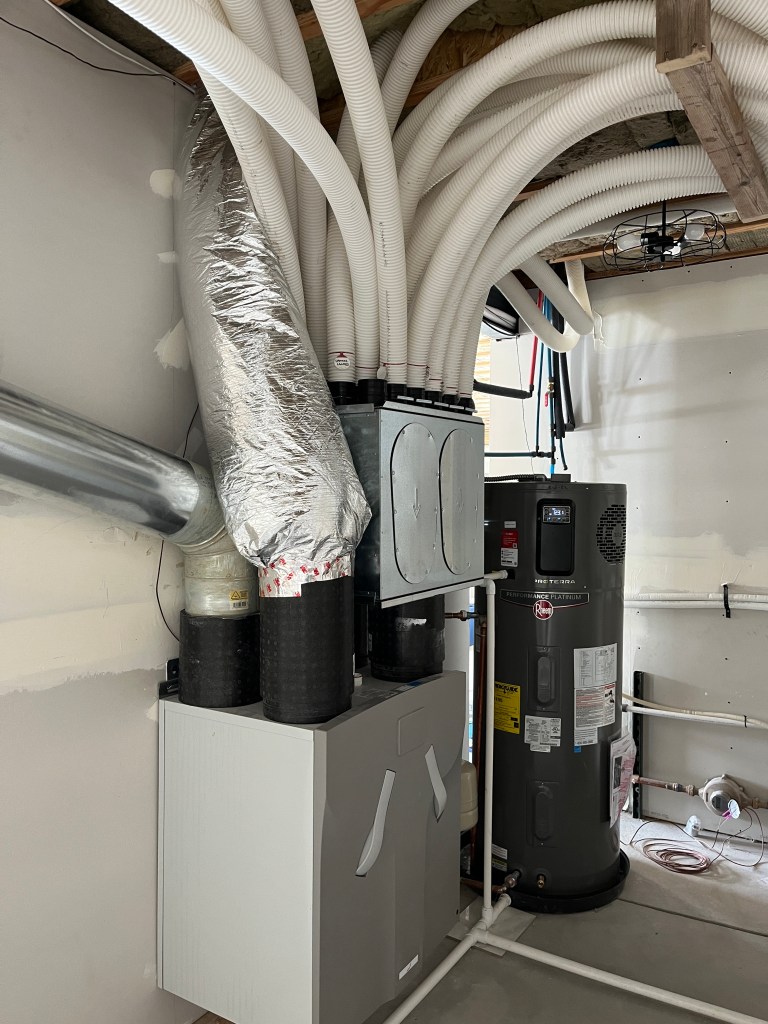
This is the Zehnder ERV at my personal home. This system services EVERY room in the house, continuously supplying fresh air to bedrooms and the living room, while exhausting stale air from the bathrooms and kitchen. This unit has a 95% efficiency rating and costs almost nothing to operate.
Why would you use a heat pump? Heat pump systems are highly efficient, can heat AND cool your home and qualify for tax credits and rebates!
Quickly, I’ll discuss the terms “mini-split”, “heat pump” and “mini-split heat pumps”.
A “split” system simply refers to the fact that there is an outdoor unit (aka a compressor) and an indoor unit (aka indoor air handler or fan coil).
“Mini-splits” are typically ductless split systems.
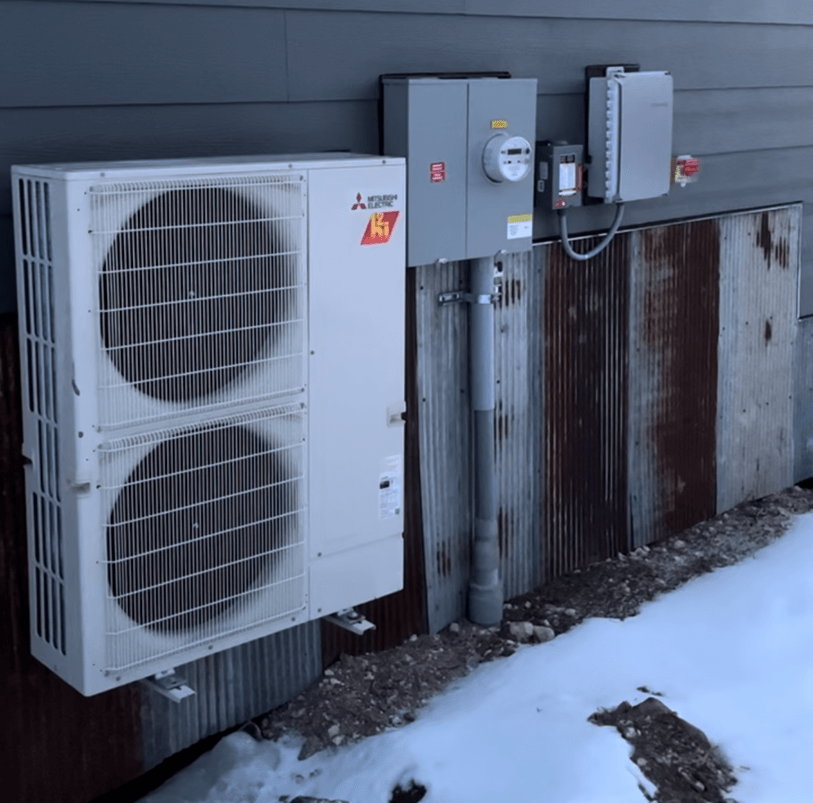
“Heat pump” refers to the type of technology that is being utilized (for example, your refrigerator uses heat pump technology and you’ll notice that it’s cold on the inside but warm underneath the unit). This type of technology is capable of heating AND cooling, but it does not create warm or cold air, it MOVES this air from the outside to inside during the winter and vice versa in the summer, utilizing the compressor, which raises or lowers the temperature as needed. A heat pump system can be ductless or ducted.
Finally, a “mini-split heat pump” is a ductless system that utilizes the heat pump technology and offers both heating and cooling.
Advantages
Efficiency – Heat pumps are typically around 250 – 400+% efficient. The industry uses a metric called the Coefficient of Performance (COP) to rate system performance. If a heat pump has a COP of 3.67 at 47F, it means that it will be 367% efficient while operating at 47F.
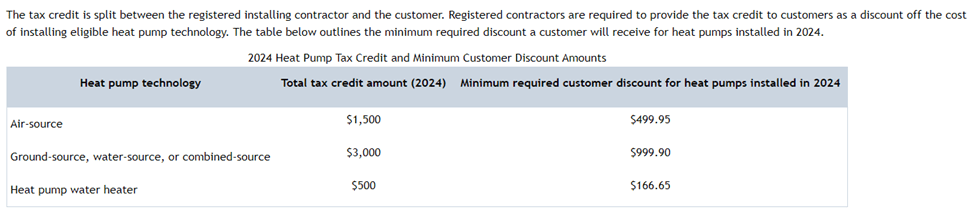
Tax Rebates – Both the State of Colorado ($1500) and local utilities offer rebates if you choose to install these and can be put towards new construction or upgrades to your existing home.
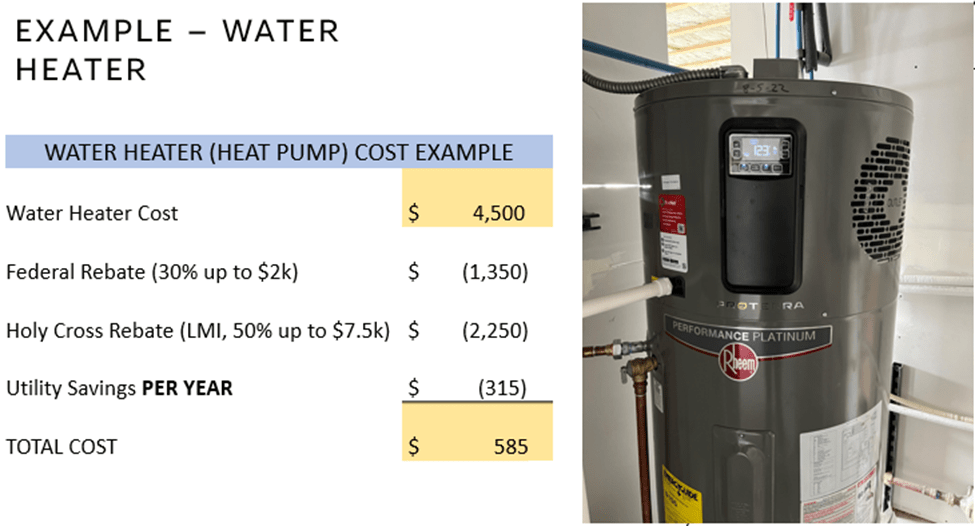
The Federal IRA, Energy Efficient Home Improvement Credit (25C) can be utilized if you are updating your existing system. The credit is 30% of project cost, up to $2,000. For more details, visit this site.
Flexible Installation Options – You can supply conditioned air to separate rooms without ductwork, and have these rooms on different temperature settings. There are also many option of inside units and additional options, such as zoning, explained below.
Installation Options – Ducted / Ductless
Now, you can choose to have a ducted system similar to a more traditional forced air furnace system, which ductwork providing heated (or cooled) air to each room via ductwork OR you can opt to have a ductless system, which would include a ceiling or wall unit in each room, where necessary, eliminating the ductwork.
Ducted – This is a good application if the heating / cooling loads per room are much less than what the indoor unit would provide, i.e. an indoor unit is typically 6k BTUh minimum, which could be much more than a bedroom actually needs. You want the heat pump to operate in it’s “Goldilocks” zone (between its minimum and maximum) and if asked to operate below the minimum, it can cycle more and have decreased efficiency. Again, a good room-by-room mechanical load calculation (Manual J) should be done to accurately design a system.
Flip Side – ductwork will supply air to each room, taking up space and may cost more; a duct leakage test will also need to be performed to ensure the air is getting where it needs to and the efficiency of the units can be realized.
Ductless – more efficient, easier to install as you don’t need to run large ductwork in the floor / ceiling / wall, but will require a separate means to get fresh air (mechanical ventilation) throughout the house. You can achieve this, however, by utilizing an energy recovery ventilation system (ERV). Please contact Full Circle on what this entails.
Installation Options – Indoor Units
What does this look like on the inside of the house? There are many options for the indoor unit. Note that you can also mix and match the unit types.
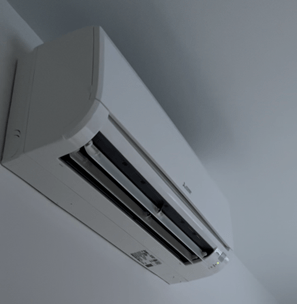
Wall-mounted units – this is the more common and cost effective measure; installed out of the way of furniture; some people do not the look of these units.
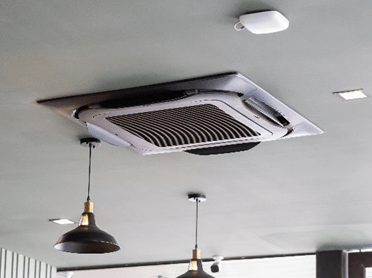
Ceiling cassette units – will be flush-mounted in the ceiling.
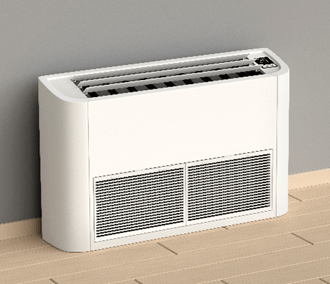
Floor units – similar to radiator units; takes up space where furniture may go.
Cold Temperature Operation
If you live in a colder climate, you will need to make sure that your mini split will operate at colder temperatures; this can be verified on the equipment spec sheet.
Some mini splits (i.e., Mitsubishi Hyper Heat (H2i) line) achieve this by running “backwards” briefly, into a “defrost mode”, to melt any ice that has formed on the outside condenser. Note that the Mitsubishi Hyper Heat line (H2i) line will operate down to 5F without any impact on the capacity / output and can operate down to -13F, with only a slight impact on capacity / output.
Some people opt to use backup heat, which is typically an electric resistance strip (installed at the unit) or could also be a fireplace or another means of heating.
Zoning
The IRC requires that each bedroom and kitchen need heating, also referred to as a “zone”. You can typically have 2-8 zones for each outdoor condenser.
You can install single-zone mini splits, which is one outdoor unit to one indoor unit, but if you’re adding indoor units to multiple rooms, you should consider a multi-zone mini split, which can have one outdoor unit and 2 to 8 indoor units.
Mitsubishi Sizing / Zoning –
2 zone / 20,000 BTUH
3 zone / 24,000 BTUH
3 zone / 30,000 BTUH
4 zone / 36,000 BTUH
5 zone / 42,000 BTUH
8 zone / 48,000 BTUH
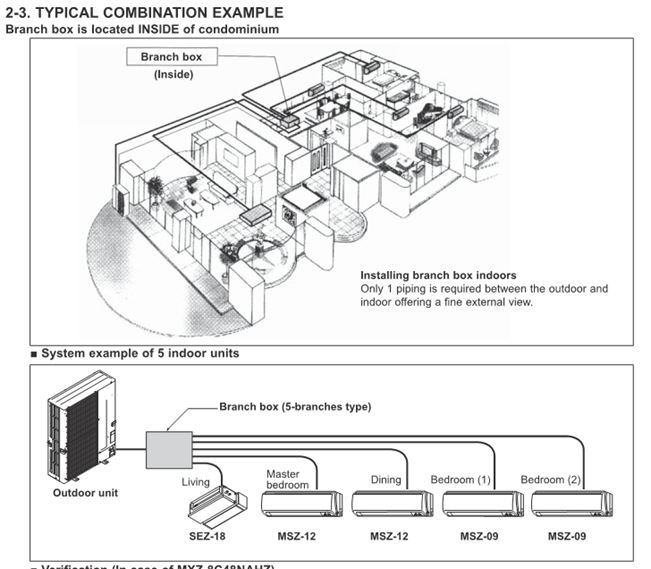
Combination Example by Mitsubishi
Branch Box – this enables you to have only one penetration in the exterior wall to run the piping lines, see photo above. If this is not utilized, you will have TWO lines per each indoor head running from the outdoor unit, to the inside, i.e. larger hole on the exterior and more refrigerant piping.
Contact Full Circle for any questions! Email: amanda@fullcircleconstruction.org
Ready to get a new water heater? Or have you been thinking about making your home less drafty and want to look at air sealing / adding insulation? There is money for you at the federal, state and local level! Get money back while saving money because you’re saving energy! We’ll discuss the different rebates available and how to get them.
Also, you don’t want to put a new, efficient motor on a boat that has holes in it. The same goes for adding insulation or upgrading your furnace, tackle the holes (and duct leakage) first, and you’ll reap the benefits!
Now it is important to know the difference between a CREDIT versus a REFUND.
Credit – You must have a large enough tax liability to take advantage of this.
Example: You want to take advantage of the $7,500 EV tax credit. You make sure you purchase a qualified EV, but you only owe the government $3500 in taxes. At best, you may get a $3500 credit towards your tax liability, but nothing else. Basically, if you do not owe that much in taxes, you will not receive the full amount. Regardless, if you’re interested in pursuing this, you can access the vehicles that qualify here. Also read on for some really neat Colorado incentives!
Rebate – You will get this money regardless of how much you actually owe in taxes. This is typically only available on a local level.
FEDERAL –
The federal government passed the IRA (Inflation Reduction Act) back in 2022 and the rebates are available until September 30th, 2031.
First, here’s some really handy websites to help you navigate this:
There are two types of credits available, one is focused on renewable energy, while the other is focused on energy efficiency upgrades to your home. There is also credits available to builders of Energy Star and DOE Zero Energy Ready Homes! Check out the IRA site here for more information.
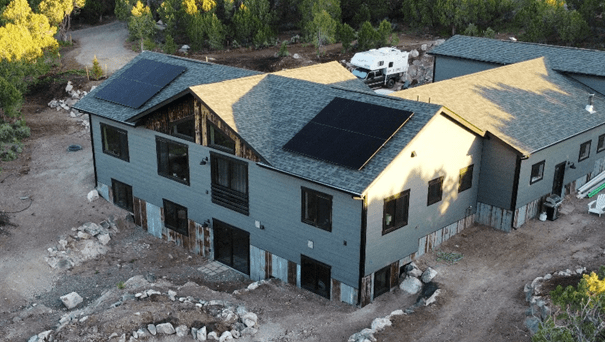
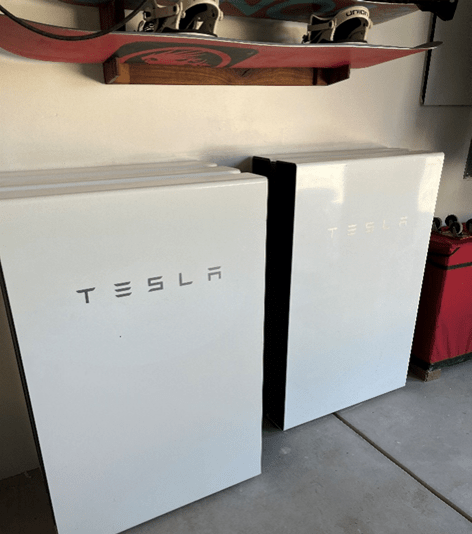
Residential Clean Energy Credit (25D) – Applicable to both new construction and existing homes. This is good for solar, geothermal and battery storage. Essentially, you will get a 30% credit on the system and there is no annual maximum or lifetime limit.
Energy Efficient Home Improvement Credit (25C) – This credit is for any window / door / insulation upgrades, new HVAC systems / water heaters and home energy audits.
The maximum credit you can claim each year is:
$1,200 for energy property costs and certain energy efficient home improvements, with limits on doors ($250 per door and $500 total), windows ($600) and home energy audits ($150).
Windows / Doors – must meet EnergyStar requirements for YOUR climate zone. Basically, just make sure your location is highlighted on the window sticker…
Insulation / Air Sealing – IECC requirements in effect 2 year prior to installation.
$2,000 per year for qualified heat pumps, biomass stoves or biomass boilers
The credit has no lifetime dollar limit. You can claim the maximum annual credit every year that you make eligible improvements until 2033. The credit is nonrefundable, so you can’t get back more on the credit than you owe in taxes. You can’t apply any excess credit to future tax years. The credit also applies to improvement to or replacement of a panelboard, sub-panelboard, branch circuits or feeders that have capacity of at least 200 amps and are installed to enable the “installation or use” other eligible property under this Section 25C.
STATE –
The state offers a few incentives, but as of August 2024, has not yet received federal IRA funding for energy rebate programs. Stay tuned to this as they should be rolled out by the end of 2024. The Colorado Energy Office is in charge of this funding and allocation so check out the website here.
These offers are currently available:
Heat Pumps – Available for many types of heat pumps or other technology. All heat pumps must be Energy Star certified.
Electric Vehicle (EV) –
State Credit – A $5000 credit is issued when you purchase or lease a new EV / plug-in hybrid!
Vehicle Exchange – Have an old car? Trade it in for $6000 towards a new EV / plug-in hybrid; $4000 when you’re purchase a new vehicle.
Weatherization (air sealing / insulation, etc.) – This service may be of no-cost to the homeowner! You must apply through the website and use a certified contractor. For the mountain area, this is the contact:
Northwest Colorado Council of Governments: 1-800-332-3669 | jhuggins@nwccog.org
Counties served: Chaffee, Clear Creek, Eagle, Garfield, Grand, Jackson, Lake, Moffat, Park, Pitkin, Rio Blanco, Routt, & Summit
Mail Applications to: PO Box 2308, Silverthorne, CO 80498
Services include: Energy audits, Energy conservation education, Air infiltration sealing, Insulation in attic, floors, and walls, Furnace repair or replacement, LED light bulbs, High efficiency appliances, Solar, Air source heat pumps
LOCAL –
When we get to the local level, there are REBATES available! No tax liability is necessary. These are mostly provided by your local utility company, Xcel and Black Hills are listed below. There are also rebates that are often matched by local non-profits who support energy efficiency and electrification.
We’ve discussed credits vs rebates, credits on the federal and state level as well as rebates on the local level. I hope that you’ll make some energy upgrades to your home soon and enjoy the increased comfort, indoor air quality and efficiency!
You don’t want your equipment cycling on and off. Not only is it not efficient, but it’s hard on the equipment and uncomfortable for the building inhabitants.
Some takeaways from the load-calcualations.com website include the following:
A Manual J load calculation is useless without the Manual S to accompany it. The Manual S provides the equipment specs and sizing to compare against the Manual J.
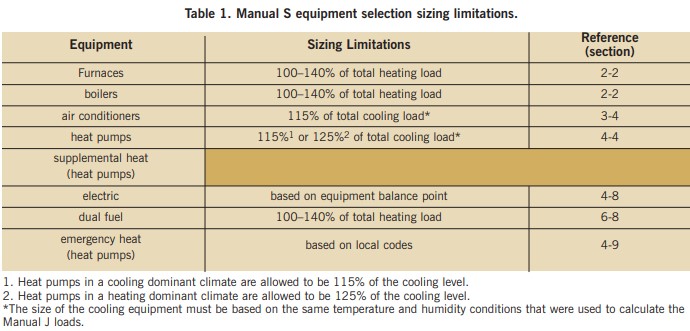
The Manual S lays out parameters including the fact that air conditioning cannot be more than 115% of the (total) calculated cooling load (heat pump cooling is set at 125%) and heating equipment cannot be more than 140% of the calculated heating load OR the next nominal size that’s available to cover the heating / cooling loads.
Do not use the AHRI Certificate for equipment sizing. The sizing needs to come from the OEM data. AHRI sets their test conditions to 80F indoor temperature and 95F outdoor. For example, in Basalt, Colorado, the (summer) indoor design temperature is 75F and the (summer) outdoor design temperature is 85F. AHRI will yield performance results from what’s actually needed.
The CFM that is calculated in the Manual J is the blower capacity needed.
Sizing limitations out of the ACCA Manual S for different types of euipment
Manual J calculations have been required by the I-codes since 2006, yet contractors still are using rule of thumb data that will most likely result in equipment that is not sized correctly.
Full Circle will perform your Manual J load calculation and will work with your mechanical subcontractor to dial in the Manual S and get equipment that will operate efficiently, saving you money and increasing indoor comfort!
Have you ever sat next to a window in a restaurant in the middle of winter and felt quite uncomfortable? Or have you sat in a conference room that has a wall of windows and also felt uncomfortable? Older or cheap windows are basically holes in the wall and tend to be quite leaky and makes the room uncomfortable. Replacing windows, however, is quite expensive. If you want to upgrade the windows without replacing them, you can consider an insert (also referred to as “storm windows”) instead! These can make the windows more comfortable while saving energy and control sound. Check out some product options below.
Indow Windows offer inserts for all sorts of projects!
The Alpen WinSert is ideal for commercial storefront / curtain / ribbon window systems. They typically need a very predictable opening and may not be ideal for historic buildings.
You wouldn’t dress the same if you lived in Florida versus Colorado, so why would you build in the same manner? Different locations have different climate zones and therefore different assembles for building. If you’re looking for assemblies specific to a cold climate, check out this video!













 Full Circle Construction Services